
Five mistakes that kill mobile app projects
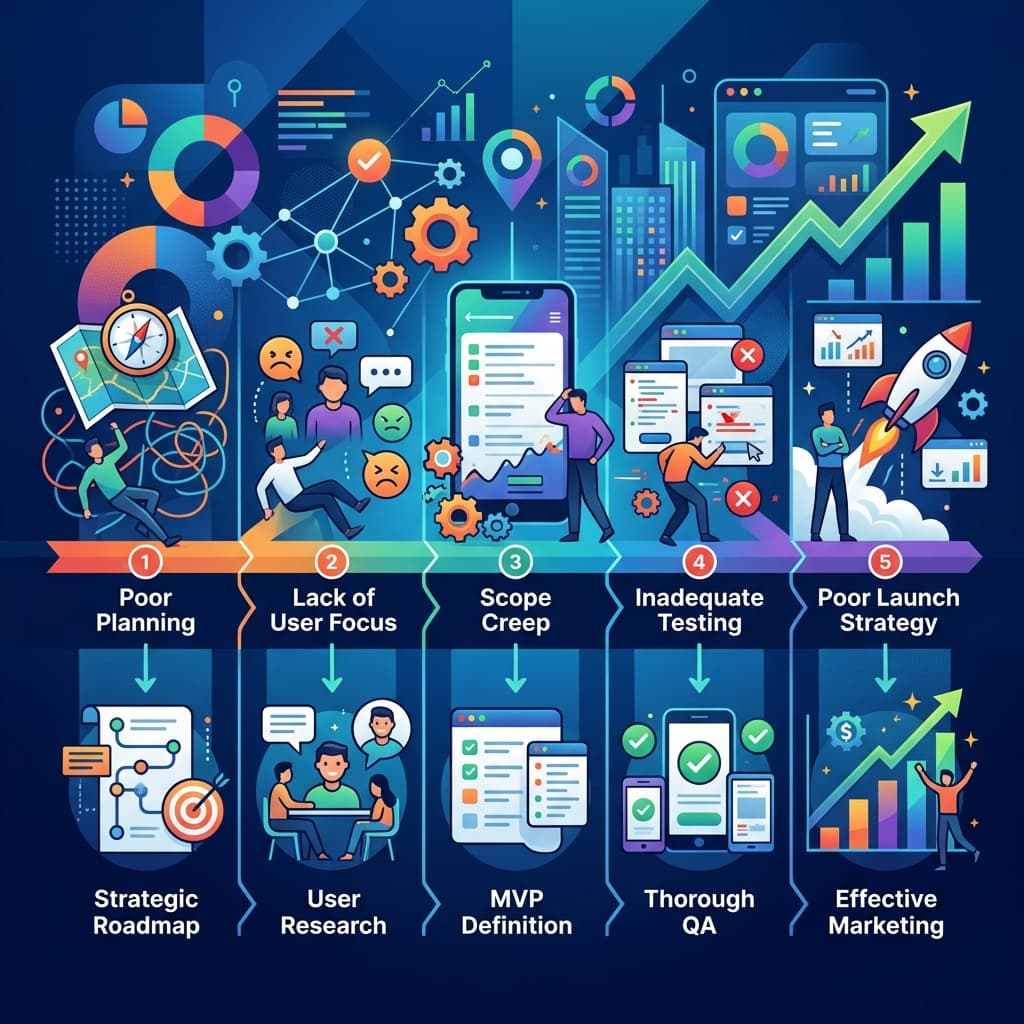
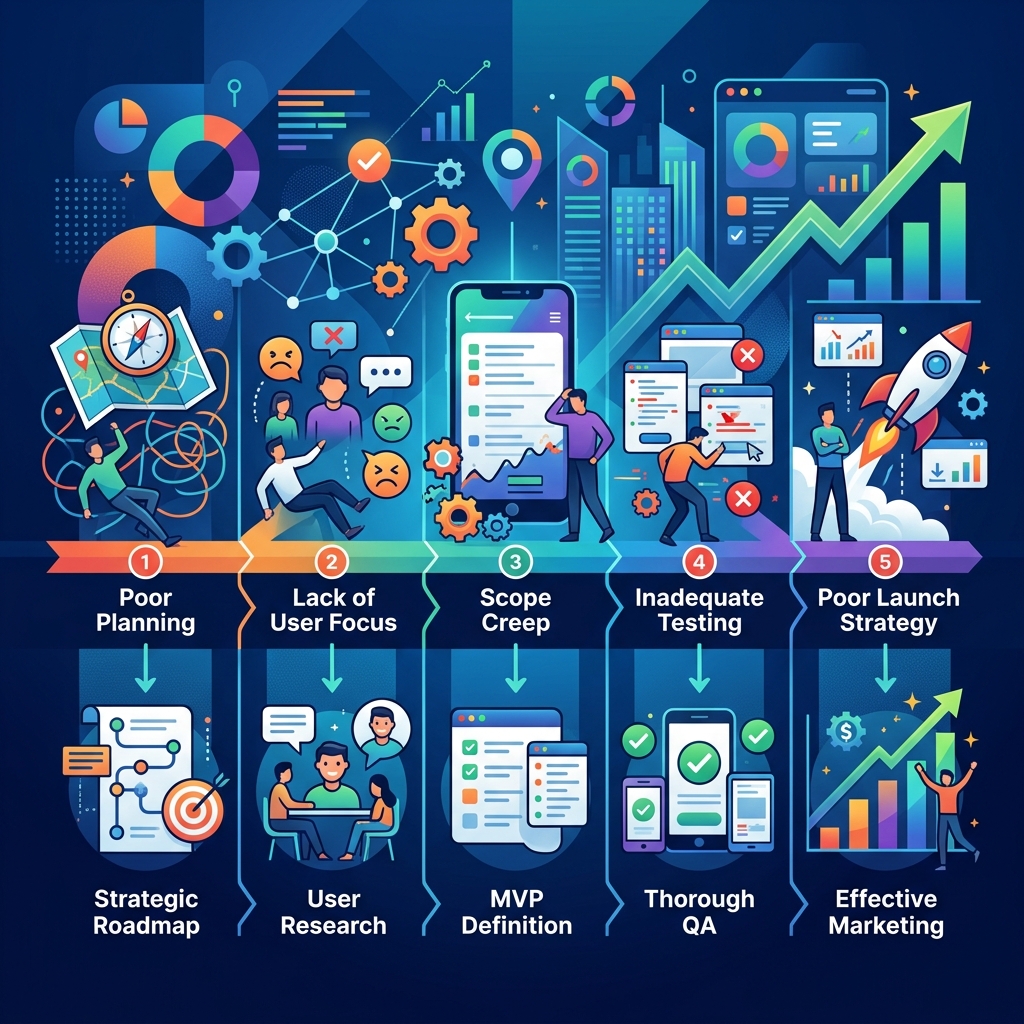
The App Store and Google Play Store are full of abandoned applications. Every year, companies spend millions of dollars building custom mobile software, only to see it fail upon launch.
When a project fails, stakeholders often point to bad code or market timing. However, the root cause is rarely the code itself. Most software failures stem from preventable planning and execution errors made long before development begins.
Avoiding these specific pitfalls determines whether you launch a successful asset or drain your budget. Here are the five mistakes that derail app projects and how proper management prevents them.
Mistake 1: Uncontrolled feature creep
Problem: Founders try to include every possible feature in their Version 1.0 release instead of focusing on a core solution.
Impact:
- Burns through the initial budget quickly.
- Significantly delays the time-to-market.
- Dilutes the core value proposition for early users.
Solution: Prioritize a tight Minimum Viable Product (MVP). Launch with only the features required to solve the primary user problem, then use real user feedback to dictate Version 2.0.
Mistake 2: Skipping professional UI/UX design
Problem: Teams skip the design phase and tell developers to figure out the interface as they write code.
Impact:
- Causes immediate user churn due to confusing navigation.
- Forces expensive engineers to act as unqualified designers.
- Leads to endless code rewrites when stakeholders dislike the visual result.
Solution: Invest in professional low-fidelity wireframes and interactive Figma prototypes before writing any backend code. This allows you to test the user journey and fix flaws in minutes rather than days.
Mistake 3: Choosing the wrong technology stack
Problem: Selecting a programming language based on internet hype rather than business requirements.
Impact:
- Causes jittery performance if forcing cross-platform tools for graphics-heavy apps.
- Pointlessly doubles development costs if building native iOS/Android for a standard B2B dashboard.
- Creates long-term maintenance overhead.
Solution: Align your technology stack with your feature roadmap. Use React Native or Flutter for cross-platform speed, native iOS/Android for hardware integration, or Next.js for web-based dashboards.
Mistake 4: Ignoring Agile project management
Problem: Using the Waterfall method to gather all requirements upfront and wait six months for the final delivery.
Impact:
- Fails to adapt to shifting market conditions.
- Breeds mistrust between stakeholders and developers.
- Allows structural bugs to remain unnoticed until launch day.
Solution: Use Agile sprints with 2-week reviews so you see working software before launch day. This continuous feedback loop allows you to pivot early and catch issues before they compound.
Mistake 5: Neglecting post-launch budget
Problem: Allocating 100% of available funding toward the initial MVP build and leaving nothing for maintenance.
Impact:
- Prevents the team from fixing edge-case bugs discovered by real users.
- Leaves the app vulnerable to OS updates that cause crashes.
- Prevents the integration of new features based on user analytics.
Solution: Budget for ongoing maintenance and server scaling by allocating 15% to 20% of your initial development cost annually. Reserve capital specifically for rapid iteration during the first 6 months post-launch.
Key Takeaway
Avoiding fatal app development mistakes requires discipline and a willingness to say no to feature bloat. By focusing on a tight MVP scope, investing in UI/UX design upfront, choosing the correct technology stack, utilizing Agile methodologies, and budgeting for long-term iteration, you increase your odds of building a successful digital product.
Book a technical strategy session to review your roadmap and define a lean MVP.
Related Articles

Unlocking growth with WhatsApp API automation use cases and ROI
If you want to communicate effectively with your customers today, you have to meet them exactly where they already spend their time. For over 2.7 bill...

SaaS development roadmap to reach $100k MRR
A complete SaaS development roadmap and guide to taking your business from a lean MVP to a profitable scaling operation hitting $100k MRR.

The hidden return on investment of good mobile app design
When founders, product managers, and executives begin budgeting for a new digital product, there is a common, often fatal, misconception: they view ba...