
SaaS development roadmap to reach $100k MRR
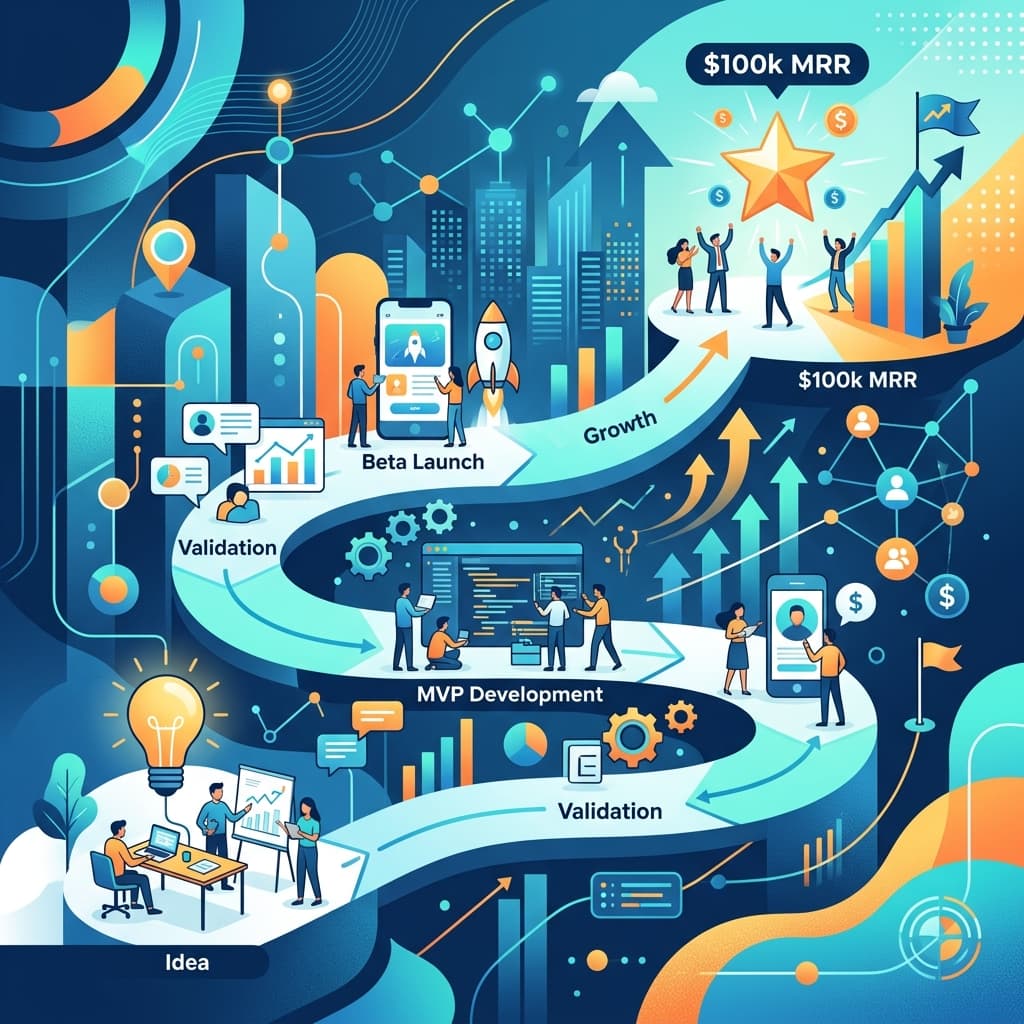
Building a successful Software as a Service (SaaS) company is the modern gold rush. The allure of the SaaS business model, with its highly predictable, compounding recurring revenue, high gross margins, and near-infinite scalability, attracts thousands of ambitious founders every single year. However, the graveyard of failed SaaS startups is vast and unforgiving.
Reaching the coveted milestone of $100,000 in Monthly Recurring Revenue (MRR) is rarely a matter of luck; it is a matter of precise execution. Hitting $100k MRR (a $1.2M Annual Run Rate) typically signifies that a company has found true, undeniable Product-Market Fit (PMF) and possesses a scalable, profitable customer acquisition engine.
To navigate this arduous journey successfully, founders need a clear, phased product roadmap. In this comprehensive guide, we will break down the exact SaaS development milestones and business hurdles you must clear to scale your idea from a napkin sketch to a $100k MRR powerhouse.
Phase 1: The Idea and Ruthless Validation ($0 MRR)
The single most common mistake first-time founders make is rushing headfirst into SaaS development before they truly understand the market problem they are solving. Before a single line of code is written, you must ruthlessly validate the idea.
1. Identify a "Hair-on-Fire" Problem
Successful SaaS products solve painful, expensive problems. A B2B (Business-to-Business) model is often the fastest, most reliable route to $100k MRR because businesses are willing to pay a premium for software that saves them employee time, reduces risk, or directly increases their revenue. Ask yourself: Is your idea a "vitamin" (a nice-to-have luxury) or a "painkiller" (an absolute operational necessity)?
2. The Pre-Code Validation Phase
Do not hire developers or open an IDE just yet. Create a high-converting, professional landing page explaining your exact value proposition and see if people will sign up for a waitlist or pre-pay for a beta invite. Conduct at least 50 direct customer discovery interviews with your exact target market. If they aren't visibly excited about your proposed solution, aggressively pivot your idea.
Milestone to exit this phase: You have a waiting list of highly targeted users or several Letters of Intent (LOIs) from businesses explicitly stating they are willing to pay once the software is built.
Phase 2: The Minimum Viable Product (MVP) ($0 to $10k MRR)
Once validated, it is time for the very first technical iteration of your product roadmap: the Minimum Viable Product (MVP). The goal of an MVP is to build the absolute minimum feature set required to deliver core value and convince early adopters to pull out their credit cards.
1. Strategic SaaS Development
Speed to market is your greatest asset in this phase. You need a robust but flexible technology stack. Frameworks like Next.js for the lightning-fast web frontend and Node.js or Python for the backend are industry standards for modern SaaS applications.
Many successful, non-technical founders choose to outsource their MVP development to specialized agencies like Vonix Soft. This approach allows founders to focus 100% of their energy on marketing and early outbound sales while engineers ensure the application is built securely, rapidly, and without fatal technical flaws.
2. Charge from Day One
The ultimate validation of any SaaS business model is revenue. Do not offer a permanently free product during your MVP phase. If your product solves a real, painful problem, early adopters will eagerly pay for it, even if the UI is slightly clunky and lacks dark mode. Charging from day one provides crucial, honest feedback on your pricing strategy and weeds out uncommitted, noisy free users.
3. Do Things That Don't Scale
In this phase, you shouldn't be relying on automated Facebook ads or complex, long-tail SEO strategies. You should be executing direct, unscalable outbound sales. Send highly personalized cold emails, send LinkedIn voice notes, and jump on hour-long Zoom calls to personally onboard your first 10, 50, or 100 customers manually.
Milestone to exit this phase: You hit the magical $10k MRR mark. This proves that strangers on the internet are willing to pay real money for your solution.
Phase 3: The Pursuit of Product-Market Fit ($10k to $50k MRR)
Hitting $10k MRR is exhilarating, but getting to $50k requires a fundamental, psychological shift in your product roadmap. This phase is entirely about retention. It doesn't matter how many new customers your marketing acquires if they all cancel (churn) after one month of usage.
1. Refining the Product Roadmap
Your early adopters will flood you with feature requests. It is critical to filter this feedback objectively. Do not build custom, one-off features for loud, low-paying customers. Look for patterns in the feedback from your most successful, highest-paying "power users." Your SaaS development focus should shift from "building cool new things" to "making the core features incredibly fast, intuitive, and bug-free."
2. Nailing Customer Success
You must become aggressively obsessed with how quickly a new user achieves value from your software (Time-to-Value). If it takes a new user three weeks of frustration to figure out how to configure your dashboard, they will churn. Invest heavily in better UI/UX design, comprehensive self-serve documentation, and proactive, empathetic customer support.
3. Optimizing the SaaS Business Model Pricing
What worked at $0 MRR rarely works efficiently at $50k MRR. You must experiment with your pricing architecture.
- Tiered Pricing: Introduce a "Pro" or "Enterprise" tier designed specifically for heavy, power users.
- Usage-Based Pricing: Charge based on the actual value delivered (e.g., number of emails sent, API calls made, gigabytes stored, or active seats filled). Raising prices on new customers is often the fastest, most effective way to accelerate your MRR growth during this critical phase.
Milestone to exit this phase: You reach $50k MRR, and your monthly customer churn rate drops below 5% (ideally below 3% for B2B SaaS). This indicates strong, undeniable Product-Market Fit.
Phase 4: Scaling the Engine ($50k to $100k MRR)
You now have a product people love, and they aren't churning. Congratulations, you survived the hardest part. Now, the challenge shifts from product refinement to scalable distribution and robust technical infrastructure. You are building a machine.
1. Predictable Customer Acquisition
You can no longer rely on founders hustling in LinkedIn DMs. You need predictable, highly measurable marketing channels.
- SEO and Content Marketing: Investing heavily in inbound content architecture that drives passive organic traffic.
- Paid Ads: Scaling Google Ads or LinkedIn Ads with a clearly defined Customer Acquisition Cost (CAC) that is at least 3x lower than your Customer Lifetime Value (LTV).
- Building a Sales Team: Hiring professional Account Executives (AEs) to handle inbound product demos and close larger, complex deals.
2. Moving Upmarket (Enterprise SaaS)
To efficiently bridge the gap from $50k to $100k MRR, you almost always need a higher Average Revenue Per User (ARPU). This means actively targeting larger mid-market or enterprise companies. Your SaaS development team will need to shift gears and build "enterprise-ready" features, such as:
- Single Sign-On (SSO) and SAML integrations for corporate IT departments.
- Advanced, granular Role-Based Access Control (RBAC).
- Detailed security audit logs and obtaining necessary compliance certifications (SOC2, HIPAA, GDPR).
3. Addressing Technical Debt
The "hacky" code that successfully got you to $10k MRR will likely crack under the immense pressure of $100k MRR traffic. As your user base and database size grow exponentially, queries slow down, and edge-case bugs multiply. You must allocate significant engineering resources to refactor the legacy codebase, optimize database indexing, and migrate to highly scalable cloud architectures (like advanced AWS or Google Cloud setups).
Ignoring technical debt in this phase leads to massive platform outages, which instantly destroys brand trust and causes devastating enterprise churn.
The Technical Foundation for Scaling
A critical, often-overlooked through-line across all these growth phases is the baseline quality of your engineering. Many non-technical founders mistakenly believe that they can build a cheap, outsourced MVP on a legacy stack and simply "fix the code later." In reality, a poorly architected MVP will collapse during Phase 3, requiring a complete, astronomically expensive rewrite that stalls product growth and sales for 6-12 months.
Choosing the right modern technology stack and the right engineering partner from day one is paramount to hitting $100k MRR smoothly.
- Next.js provides unparalleled frontend performance, server-side rendering, and vital SEO optimization for your marketing pages.
- React Native or Flutter allows you to seamlessly launch companion iOS and Android mobile apps without the massive overhead of maintaining completely separate Swift and Kotlin codebases.
- Scalable Backend Architectures ensure that when your marketing team successfully acquires 1,000 new users in a single day, your servers effortlessly handle the load without crashing.
Accelerate Your Journey with Vonix Soft
Navigating the treacherous transition from a whiteboard idea to a $100k MRR SaaS business is incredibly complex. The absolute last thing a founder should worry about is whether their technology will scale under pressure.
At Vonix Soft.com, we specialize in , end-to-end SaaS development. We partner with visionary founders to architect, build, and seamlessly scale high-performance software products.
Whether you are in Phase 1 and desperately need a rapid, highly polished MVP to capture early adopters, or you are in Phase 4 and require a team of senior engineers to refactor your architecture for SOC2 compliance, our team of experts provides the heavy technical muscle you need. We don't just write code; we meticulously align our technical architecture with your SaaS business model to ensure maximum ROI and speed-to-market at every single stage of your growth.
The path from an initial idea to $100k MRR is not a straight, easy line. It is a grueling, iterative process that requires deep market understanding, a ruthless focus on customer retention, and rock-solid technical execution.
By closely following a structured product roadmap, validating the market first, launching a lean MVP quickly, obsessing over Product-Market Fit, and finally scaling your acquisition engine, you Significantly increase your odds of building a highly profitable, sustainable software company.
Focus entirely on the customer, iterate rapidly based on their feedback, and ensure your underlying technical foundation is built to scale from day one.
Ready to Build Your SaaS Empire?
Don't let technical bottlenecks or poorly architected code slow down your MRR growth. Partner with an agency that understands both beautiful code and SaaS economics.
Schedule a free SaaS architecture consultation with the engineering experts at Vonix Soft today. Let's discuss your product roadmap in detail and build the scalable software you need to reach $100k MRR and beyond.
Related Articles
Unlocking growth with WhatsApp API automation use cases and ROI
If you want to communicate effectively with your customers today, you have to meet them exactly where they already spend their time. For over 2.7 bill...

The hidden return on investment of good mobile app design
When founders, product managers, and executives begin budgeting for a new digital product, there is a common, often fatal, misconception: they view ba...
Seven AI automation tasks to drive business growth
As a business owner, your most constrained and valuable resource isn't capital, it is time. Every hour spent on repetitive, manual tasks is an hour sto...